Why I believe traditional Pilates training will shape the next generation of Pilates instructors.
I’ve been thinking about this a lot recently; have we ended up in a place where Pilates has become a bit…Reformer-only?
I’m not even sure if that’s what people actually want, or if it’s just what’s easiest to sell, and what everyone now expects when they hear Pilates, especially with the current Reformer Pilates boom in the UK.
Don’t get me wrong, I love Reformer Pilates, it’s brilliant, but I do sometimes feel like we’ve taken something that was originally much bigger and squeezed it into just one part of the system. It was never just the reformer.
If you look back at how Pilates was originally taught, it wasn’t like that at all.
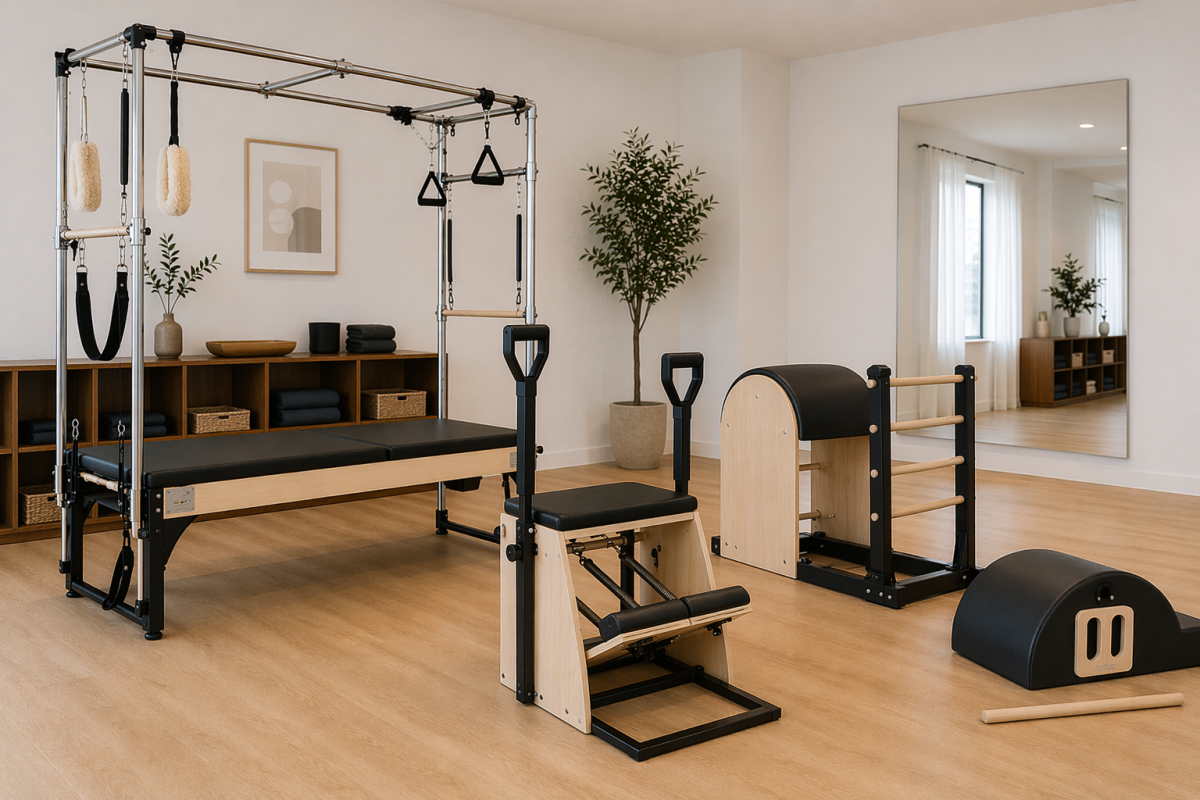
Clients weren’t just put on a Reformer and kept there, they moved between different pieces of equipment, the Chair, the Cadillac, the Ladder Barrel. Often working on similar movement patterns, just approached in slightly different ways.
This is what traditional Pilates equipment training looked like, the equipment was part of it, but the focus was always the movement.
The “How Many Reformers in your studio?” Question
I get asked this a lot, especially in conversations about studios or building a Pilates career in the UK, how many reformers have you got? And if I’m honest, it always feels a bit like a confession, like I’m about to admit something I probably shouldn’t.
I’ve only got two, which still sometimes makes me pause for a second and wonder how that might come across. But the truth is, that’s simply not how I was originally taught, studios with rows and rows of reformers just don’t resonate with me in the same way.
I trained in the original APPI studio in Hampstead, which was a full equipment studio. The Chair, the Cadillac, the Barrels, everything was part of the day-to-day, and we’d all be teaching different things on different pieces of equipment, constantly picking up ideas from each other. There’d sometimes be a Mexican wave of us all teaching something similar with our clients as we were reminded of some great piece of choreography from a colleague.
Before Instagram existed, that was how you learned as a Pilates instructor, and I don’t think I’ve ever really been able to strip that out of how I see Pilates.
Once you’ve experienced it like that, it becomes very hard to ignore what each piece of equipment brings to the overall picture, and that’s why I still come back to it, not because I’m against Reformers, far from it, but because I don’t think they were ever meant to do everything on their own.
Why This Matters for Pilates Training
This is why I think the Chair, Cadillac and Barrels course matters, not because it’s “more equipment”, but because it gives you more ways to think.
You start to see how the same movement translates across different pieces of equipment, you start to understand what each one offers, and you stop defaulting to what’s familiar and start choosing with a bit more purpose.
That’s the shift from basic certification to more advanced Pilates instructor training.
And I notice this even when I’m teaching the Reformer course at APPI, because even though I’ve just rewritten it, there are still moments where I can’t help myself, I’ll jump onto another piece of equipment and show how it translates, how the Chair might offer a similar option, or how the Cadillac or Tower might give a slightly different feel.
Because once you see it like that in practice, it becomes very difficult not to start thinking in that broader way.
And if I’m honest, this isn’t just about how I was taught, it’s also how I had to start, because when I first opened my studio 20 years ago, I couldn’t afford a bank of reformers, it just wasn’t realistic, so I bought what I could, things like the Chair, pieces that gave me more for less.
But it actually worked better in a lot of ways, especially as I was working with a lot of athletes and trying to bring them into Pilates, because they didn’t want to lie on one machine for an hour, they wanted to move, they liked the change, and they got more into it when they were moving around the studio.
It felt less like “doing Pilates” and more like training, and looking back, that wasn’t a compromise, that was Pilates beyond the Reformer.
A More Authentic Way Forward
The Reformer boom has been brilliant for the industry, but once that settles, it becomes less about what you teach, and more about how and why you’re teaching it.
And this is where working across all the equipment really changes things, because it makes it more enjoyable, both for you as the instructor and for the client, and it feels more bespoke, as you’re not just working through a set sequence, you’re choosing the right combination of equipment and exercises in the moment.
That also shows your range as an instructor, and from the client’s point of view, it changes things as well, because when they experience the same movement in different ways, on different pieces of equipment, their learning is better and it sticks.
Whereas if we keep repeating the same thing on the same piece of kit, you tend to stop learning after a while, and I think that’s the shift.
If you really want to understand Pilates, and not just deliver it, you have to look beyond the Reformer and start exploring the rest of the system, because that’s where things start to make more sense and where your teaching really starts to move on.
Final Thoughts
We’ve almost normalised the idea that equipment Pilates means a room full of reformers, but it never really was, and I don’t think it should be.
There’s a place for mat as well, to really find those basics, but how it was originally taught was about learning movements across the full range of equipment, and that’s where you start to understand it properly.
When you see the same movement in different ways, in different contexts, it builds a much deeper understanding of Pilates.
And that’s why I’m so excited about the full equipment certification training, because for me it just feels like the right direction, more complete and more in line with what Pilates was always meant to be.
Written by:

Dawn Buoy
Global Education Advisor, APPI